The post Worldschool Spring Semester 2013: The Great Gaelic Games first appeared on OliverTheWorld.
]]>Dublin & Kilkenny, Ireland

In Ireland earlier this spring, we had the opportunity to learn about the fascinating and ferocious (fascinatingly ferocious?) world of Gaelic sports. And while I’m not referring to competitive Guinness-swilling, I have been a witness to that at one point in my life, and I can attest that it is fascinating in quite its own way…
While Ireland like much of the European world stands wholeheartedly behind both their rugby and football (soccer as we gringos call it), what intrigued us most were the two ancient sports unique to the island and incidentally, most loved by its citizens: Gaelic football and hurling. Both sports are as old as the Hills of Tara and predate Irish history.
[tubepress video=”TEAbWrdB9XU”]
For anyone who has visited Dublin’s impressive Croake Park, it’s fairly easy to see how Gaelic football is one of Ireland’s sacred pastimes. Teams of fifteen play on a rectangular grass pitch with H-shaped goals at either end. Scoring is achieved by kicking or hand-striking something that vaguely looks and feels like volleyball either through the goalposts or over the bar. Defensive play falls somewhere between Association football and rugby, which is to say that there is tackling but without the carnage. If it sounds like Aussie Rules, that’s because Gaelic was its inspiration; waves of immigrants brought the sport with them. Like all Gaelic sports, it is technique-driven, fast paced, and is a high-scoring game.
[tubepress video=”TmzivRetelE”]
Hurling, as they say, is “the fastest game on grass”. I find that the best way to consider it is to visualize a union between Hercules and a cheetah, and then to imagine their offspring has been expertly instructed in lacrosse, field hockey, baseball, and the finer art of that game that involves running, while balancing an egg on a spoon.
Teams of fifteen players face off on a rectangular pitch with H-shaped goalposts at either end. Armed with hurling sticks (“ a hurley”) that have the appearance of a field hockey stick with a slightly wider striking end, the players manipulate an extremely small, extremely hard leather ball (“a sliotar”) both on the ground and in the air as it travels at speeds in excess of 150km/h (93mp/h). Agility and razor-sharp eye-hand coordination are critical. While the ball can be picked up off the ground with the stick and carried by hand, strict rules dictate how many steps the players can take, and most get around this by racing full speed down the pitch while balancing the ball on the flat end of their stick. Other mind-boggling techniques include the “overhead catch” or the “running strike-out-of-hand”. Hooks, checks, blocks and slashes to the face are all de rigueur. If the game sounds terrifying, consider this: the goalies don’t wear gloves, cups, facemasks, or any padding at all!
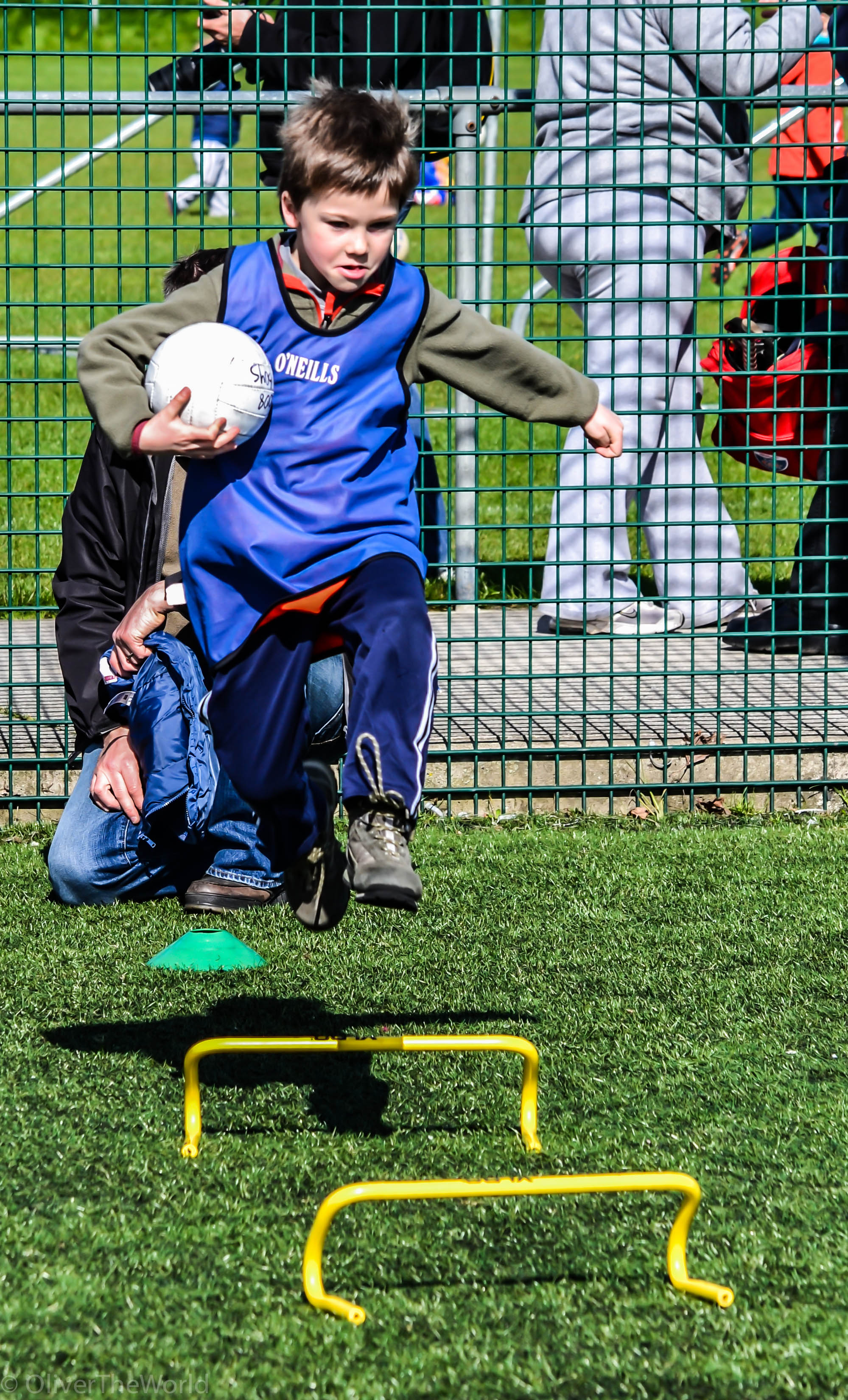
So of course we did what was natural, and in an effort to broaden our children’s exposure to the various cultural elements of whatever country is hosting us at the time, we threw him straight to the wolves. We enrolled Oliver in a day of Gaelic sports with the wonderful outfit Experience Gaelic Games located just outside of Dublin.
It was a beautiful day in late April that made for a fine family event. Ryan’s parents were visiting from California, and with our gracious host Georgina, we acquainted ourselves with the history and rules of both games and Oliver was explained what to expect. After that, he was led out onto the pitch where 300 Irish kids between the ages of four and seven years had arrived for the “Club Nursery” Saturday session. Talk about immersion!

For the better part of the morning, Oliver participated in a series of drills aimed at introducing him to the two sports. As Kendley batted around a mini-football and had her path diverted from stampeding six year olds with hurling sticks by her watchful grandparents, Ryan and I cheered on Ollie and his pint-sized teammates as they slalomed around cones and swatted at tethered sliotars. A bevy of coaches, several who were players themselves, organized scrimmages that were as entertaining to watch as the real thing. A handful of stout little Irish kids appeared to be future athletes themselves, as could be seen in the way they handled their hurlies or maintained steady ball control while their peers attempted to dive bomb their every turn. For his part, Ollie was simply overjoyed to run and tussle with kids his own age, and if he absorbed any of the rules of either game, all the better. Our morning with Georgina, her lovely daughter Muire and the rest of the team at EGG was easily the highlight to our time spent in the Dublin area, and it of course made for some very good action photography.


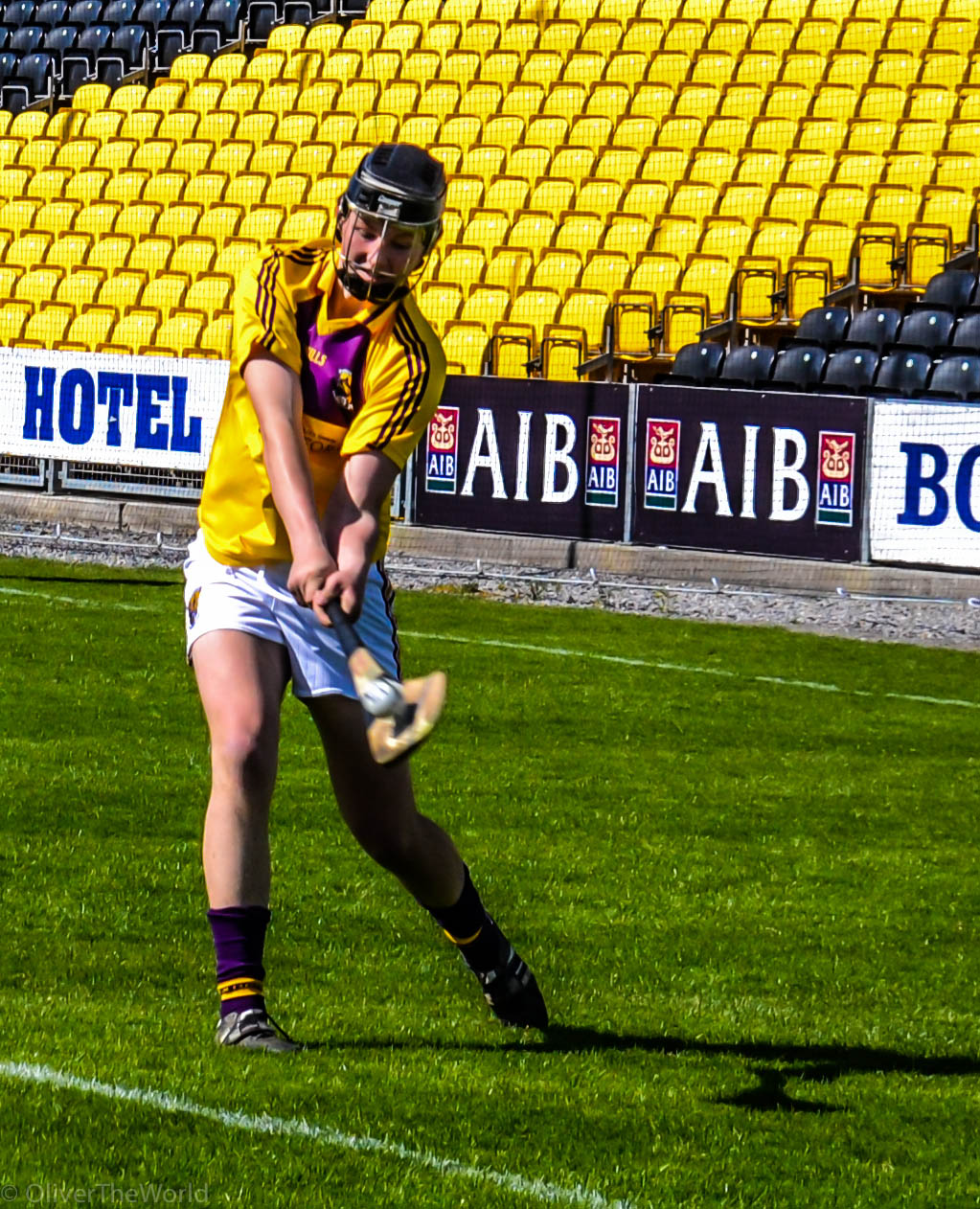
A few weeks later, we did have the opportunity to take in the “real thing”, which came in the form of a Wexford vs. Kilkenny hurling match. Val, our new friend and Kilkenny local, hooted and hollered for her home team as I cringed and ducked my head at some of the more grisly plays.

“Ack! That goalie isn’t wearing a cup! Isn’t he too young to decide now that he doesn’t want to father children some day?!” I cried after a ball ricocheted at warp speed in the direction of the Wexford guy’s groin. Val answered me, nonchalantly. “None of them are wearing a thing down there. That’s what the boys have two of em’ for!” I was reminded also that both hurling and Gaelic football have long observed the tradition of being purely amateur sports, in the sense that anyone can play at their local GAA (Gaelic Athletic Association), and that the top players from every league don’t get paid a cent.
“All for pride and passion”, I murmured as one of the players tore down the field at full tilt, the ball balanced on the flat part of his stick. He wheeled around suddenly and in one fluid movement, cracked the ball out of his hand, sending it down the field where his teammate leapt up and caught it in mid-air…with his BARE HAND. Val nodded and turned to me. “Tis’ why we start them young!”
Explore Gaelic Games is based at the Na Fianna GAA Club on Mobhi Road in Glasnevin, which is about a ten-minute drive from the center of Dublin. Both the No. 4 and No. 9 bus from the center of town drop of very close to the facility. Georgina and her staff can be reached via the website: www.experiencegaelicgames.com. GAA game schedules can be found here: http://www.gaa.ie
The post Worldschool Spring Semester 2013: The Great Gaelic Games first appeared on OliverTheWorld.
]]>The post Off the Beaten Path in Ireland: The Road to Torr Head and Carrick-a-Rede first appeared on OliverTheWorld.
]]>Northern Ireland

If there was a way to somehow distill the essence of Ireland such as to contain it in a bottle so that it could be taken as an elixir at the end of a particularly long and difficult day; a sort of tonic that could lift the senses and revitalize a weary heart; perhaps that could be achieved if one set forth on a sunny day from the small town of Cushendun on the Torr Road towards Ballycastle.
Now, folks savvy with their geography might already have spouted off that the town of Cushendun lies smack in County Antrim, which puts it firmly into the territory of one Northern Ireland that lies under the jurisdiction of the United Kingdom, per the treaty that ended the Irish War of Independence in 1921. This arrangement is an undeniable fact, though there have been many folks (particularly those from West Belfast) who have sacrificed their lives and the lives of others in defense of Irish sovereignty. Nationalists and Unionists aside, for our purposes the land I am about to describe belongs to the ancient kings of Ulster and the Red Branch Knights. So, with nary a Union Jack in sight, this part of the country seemed to me, as they say, just as Irish as all the grass in Kerry.

Completely by accident, we found this road along the cliffs, and having done so, we might just have discovered the finest stretch of roadway in all the isles. Coastlines have a way of drawing us to them like a magnet, so it was no wonder that we dimmed down the volume on our GPS, which, ever since we turned out of the driveway of the inn we crashed at the night before, had bleated at us to take the next turn onto the A2. Rather than opting for that faster, better-maintained roadway that linked the two towns, we passed right through the signage alerting us of the single-track road prone to sudden closures ahead, ignored the notices urging trailers and caravans to turn back, and began to climb up the road to Torr Head.
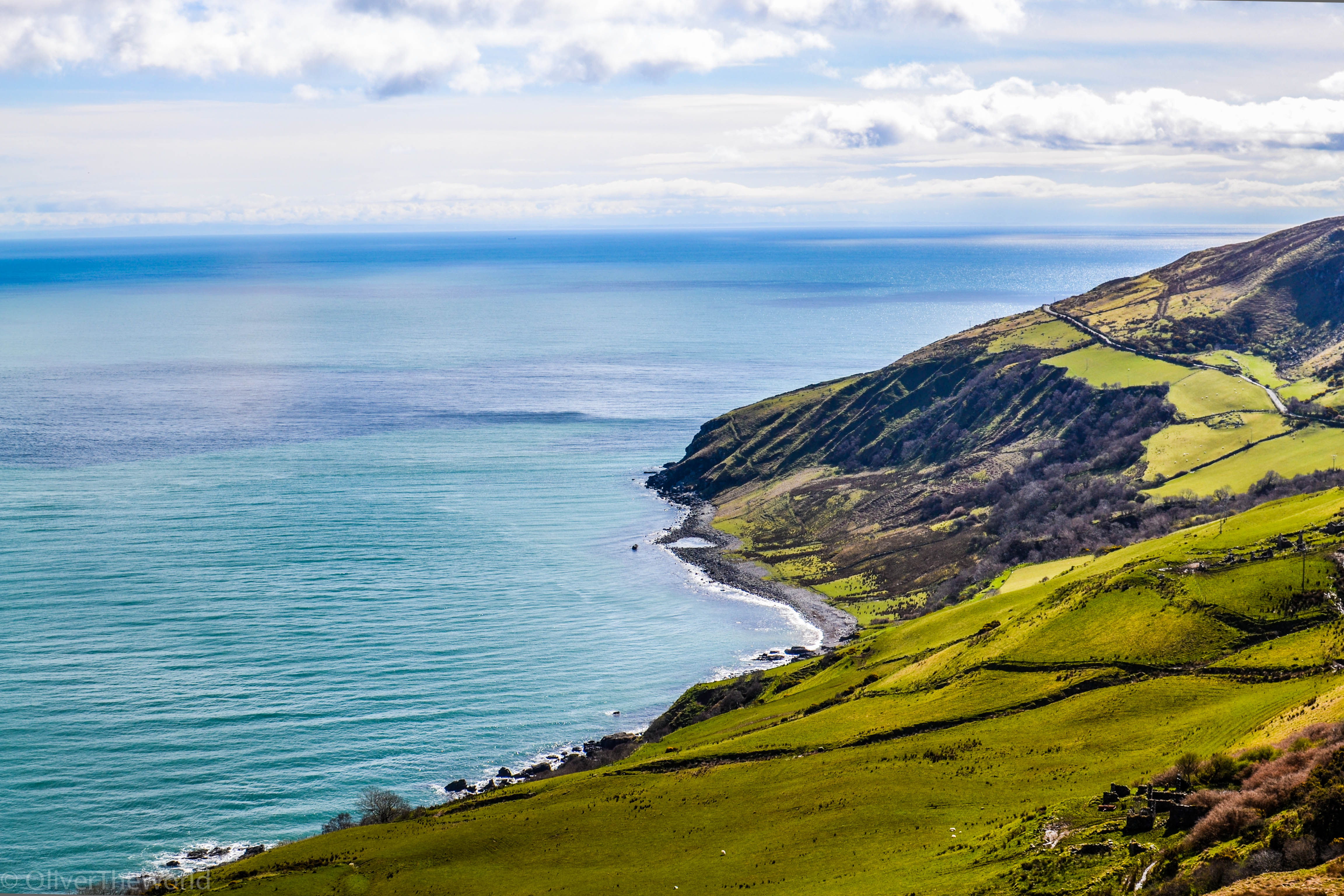
This road appeared to have been hand-chiseled out of the side of a grassy cliff that plunged several hundred meters down to a glassy mineral-blue Irish Sea. Sheep and gnarled gorse shrubs jostled for a bit of purchase here and there, the later a riot of yellow that jeered in response to the sunlight that morning. I imagined that gorse all over Ireland asked the same question of the sun, as it did that very morning: “who are you that disappears from time to time and leaves behind nothing but gray skies, day after day? We are always bright for this land; we can carry the light of day when you are nowhere to be found!”
To the despair of farmers across the county, scarcely a month had passed since unseasonal snowdrifts had swallowed the first of the year’s lambs. When we arrived in Dublin in late March, the snows followed our heels clear all the way County Kildare as we fled west toward the coast. But on a day like this one, even as far north as we were, there was indeed no sorrow in the countryside and winter’s bite had since released its hold. Spring was bounding forth everywhere we turned our eyes; it erupted in streams from the mouths of roadside daffodils.

Kendley napped as was her custom in the late morning as we snaked along a rollercoaster of green, blue and limestone. Oliver shuffled a deck of Angry Bird playing cards and lifted his gaze here and there when Ryan or I ‘oohed’ or ‘ahhhed’ at the more dramatic turns in the road.
The horizon was brindled with high, passing clouds and the Mull of Kintyre off Scotland’s southwest coast, clear in the distance, seemed close enough to skip a stone all the way to Cambeltown. We had read that emigrated Scottish clansmen relied on the strategic position of the headland as a base to send signals to their allies back on Argyllshire. An abandoned 19th century coastguard signal station built over the remains of a 2,000 year-old ring fort stood quietly at the farthest tip of Torr Head and evoked two different eras in the span of a moment.
Jewel tones abounded. Pasturelands were hemmed into wobbly parcels that vanished vertically into the horizon where it met the sea. It ended as quickly as it had begun. The road made a swan’s neck turn inland toward Ballycastle and the sea retreated to the west behind us.
Not long after leaving the Torr Road, we had returned to the coast and were easing along a lane that brought us to Carrick-a-Rede and its famous rope bridge. While most travelers along the Causeway Coastal route continue straight on through to Giant’s Causeway, we knew to give this particular place a stop, if only to elevate our heart rates for the afternoon.
For 350 years, local fishermen with a penchant for adrenalin kicks had strung a rope bridge 98 feet above a 66-foot chasm to connect the mainland to the offshore islet of Carrickarede (literally, “rock in the road”) in a clever attempt to reach the sheltered waters that harbored salmon as they migrated around Ireland’s northern coast. Today, the bridge is owned and expertly maintained by the UK’s National Trust, and for five euros fifty, brave travellers can make the crossing themselves.

At our approach, the wind kicked up and the bridge began to sway. Nesting kittiwakes and guillemots wheeled in the updrafts below us, and when I looked down between the slats in the bridge, the tiny hairs along both of my arms stood straight us against the wind. I do believe if it weren’t for Oliver and Kendley hauling me like a team of draft horses, I would have remained there forever, clutching the handrail and whimpering like a fool.
To be fair, it was FAR from the worst swing bridge we had ever crossed. In Nepal and Laos, several rickety things slung a hundred feet above dry riverbeds come to mind. I was fortunate that Carrick-a-rede, with its steel cables and 10-ton load capacity, was well equipped to convey heavy Western bodies.
Safely deposited on the other side, the kids squared themselves away among tall grasses to pluck at pioneering dandelions, leaving Ryan and I to skirt the edge of the little islet where it dropped down into the sea. A microburst was curling around the northern headland and making a direct line for us. An angled path of rain sheeted down, and the approaching clouds were gunmetal against the sea. These micro-storms in Ireland are not unlike those that track over Bali or more tropical zones; they tear down a coastline with all the ferocity nature can muster, only to retreat in a moment’s time back out over the Atlantic. The rains come, and then they are gone.

Despite knowing this, we were without shelter on Carrick-a-rede, and our escape back to the mainland was entirely dependent on re-crossing the rope bridge. Thanks to lack of foresight and the illusion of a deceptively beautiful day, we were all jacketless and to make matters worse, Kendley had the early makings of her second Irish head cold in a series of three (the first acquired on the Beara Peninsula, the last in County Kilkenny). Jousting for a place in line among the healthy barrage of Chinese tourists who had descended on the islet shortly after our arrival, we shuffled across the bridge just as the first gale of the storm enveloped us. The bridge keeled left and right and the constant footfall across its rails set it bucking from front to end. I clutched Kendley with all my might (she led the way), and moaned softly for the entire two minutes it took to cross the chasm.

And just like that, it was sunny again; the islands off the coast visible where the clouds had been swept away. Next stop, Giant’s Causeway, where I would endeavor to keep my feet on firm ground.
The post Off the Beaten Path in Ireland: The Road to Torr Head and Carrick-a-Rede first appeared on OliverTheWorld.
]]>The post Off the Beaten Path in Ireland: Escaping the Ring of Kerry first appeared on OliverTheWorld.
]]>Iveragh Peninsula, County Kerry, Ireland
Many things have been said of Ireland’s Iveragh Peninsula, which is better known for the (in)famous coastal road that circumscribes it: the Ring of Kerry. The “inspiration of poets and writers”, “magnificent coastal scenery”, a “mystical & unspoilt region”, are the words of some. In actuality, and outside a smattering of pretty beaches near the southern tip, the Ring is a tourist trail, plain and simple. And it is one that is known to become so congested in the on-season that most travelers recommend self-driving it counter-clockwise, so as to avoid being run off the road by the massive tour buses that plough through from the opposite direction.
Having driven on the Amalfi Coast this past September, we no longer feared any tour bus on earth, so we chose to drive the Ring against the flow of traffic in the clockwise direction. The parts “best saved for last”, Coomakista Pass with its views of the Skelligs and the beaches of Derryname Bay and Caherdaniel were indeed worthy diversions, but Ryan and I found ourselves questioning whether the entire 110 mile journey was indeed worth the cost of petrol. Long slogs on bracken-hedged strips of roadway dominated most of the trip, and one small, dusty town after another appeared at random; their only apparent purpose to snare passing tour groups who paused en route for lunch. Ryan’s parents had arrived from California the week prior to accompany us through Ireland and, despite their good humor and excellent company, it was clear the long drive was taking its toll on them as well.
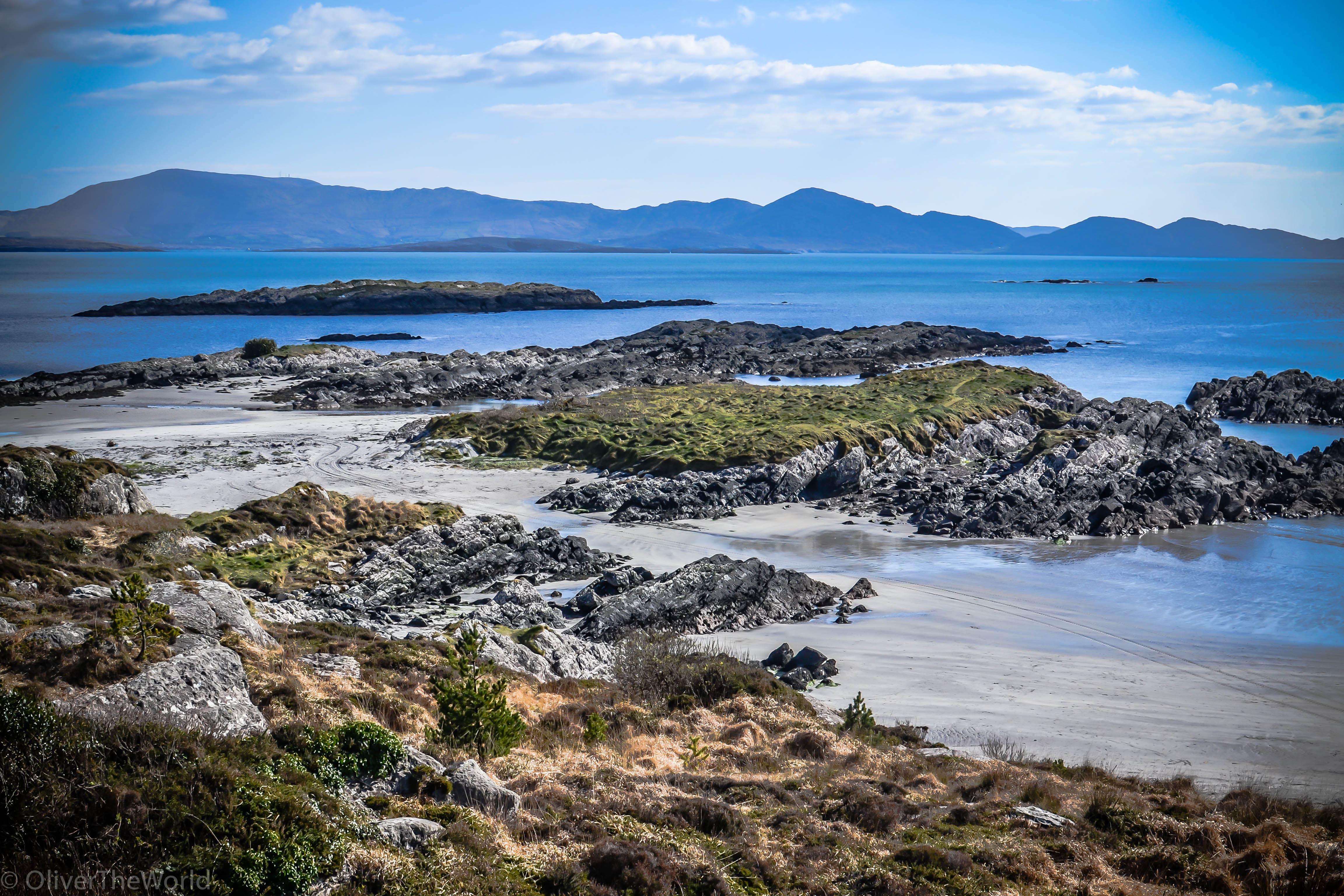
It was no surprise then, that when we pulled off near the “top” of the Ring in at our rented home in Treanmanagh near Glenbeigh, we considered moving on to the Dingle Peninsula sooner than we had planned. That was when we met Owen, the cottage-owner’s father who would look after us during our stay.
We grumbled a bit about our road-weariness and the increasing number of people on the road but out of respect for our host, we discreetly kept our feelings of having been largely underwhelmed by the Ring to ourselves. Despite our best efforts at graciousness, Owen smiled and nodded knowingly. His eyes glittered like the sea out to the Skelligs when the wind came across the bay from the mountains. He knew much about this little pocket of Ireland, and he lit up a spark when he knew we were game to get off the path.
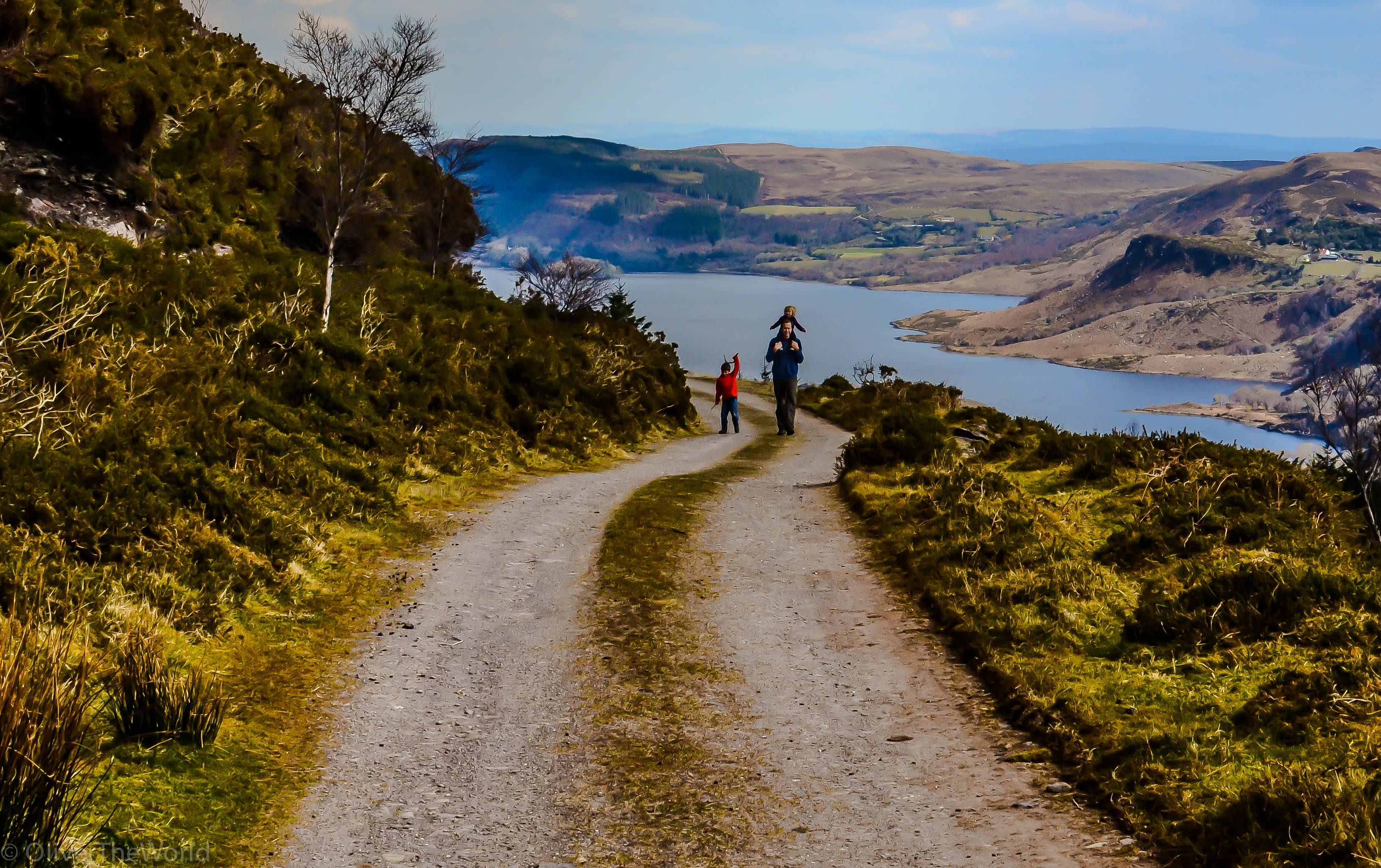
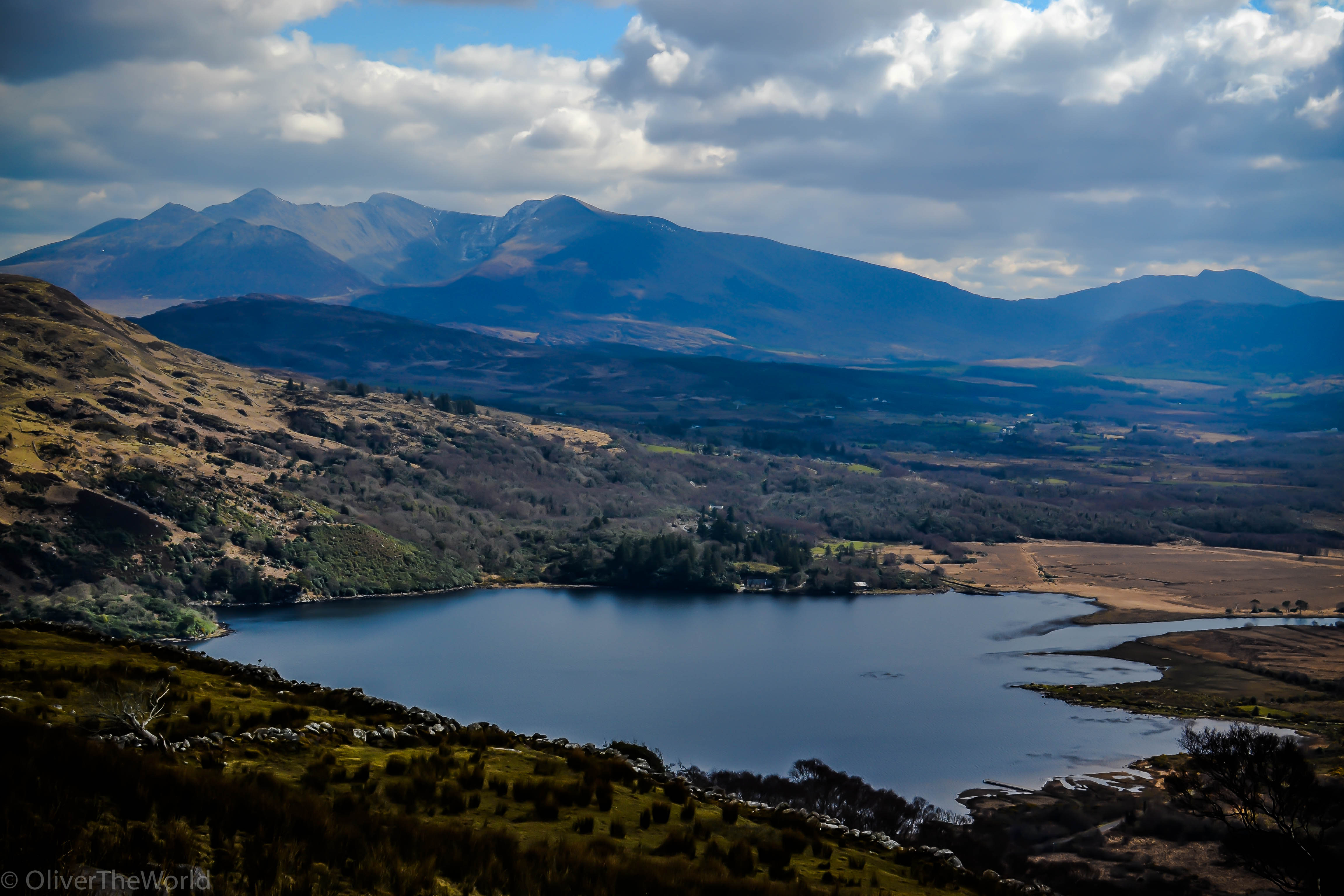
“Do yourself a favor now, lads. Go up the road a bit left out of the cottage. Follow it up a’ways; no matter the state of the road, you’ll be grand with that vehicle, until you see the lake down below. Lough Caragh. Up there, I promise, you will find God.”
So up we went, and Owen was right in every sense. The road climbed between mountain pastures that could have been home in the wilds of inland northern Greece. The lake held the angle of the sun at its fullest and violet shadows edged into the valleys between Macgillycuddy’s Reeks, Ireland’s highest mountains.
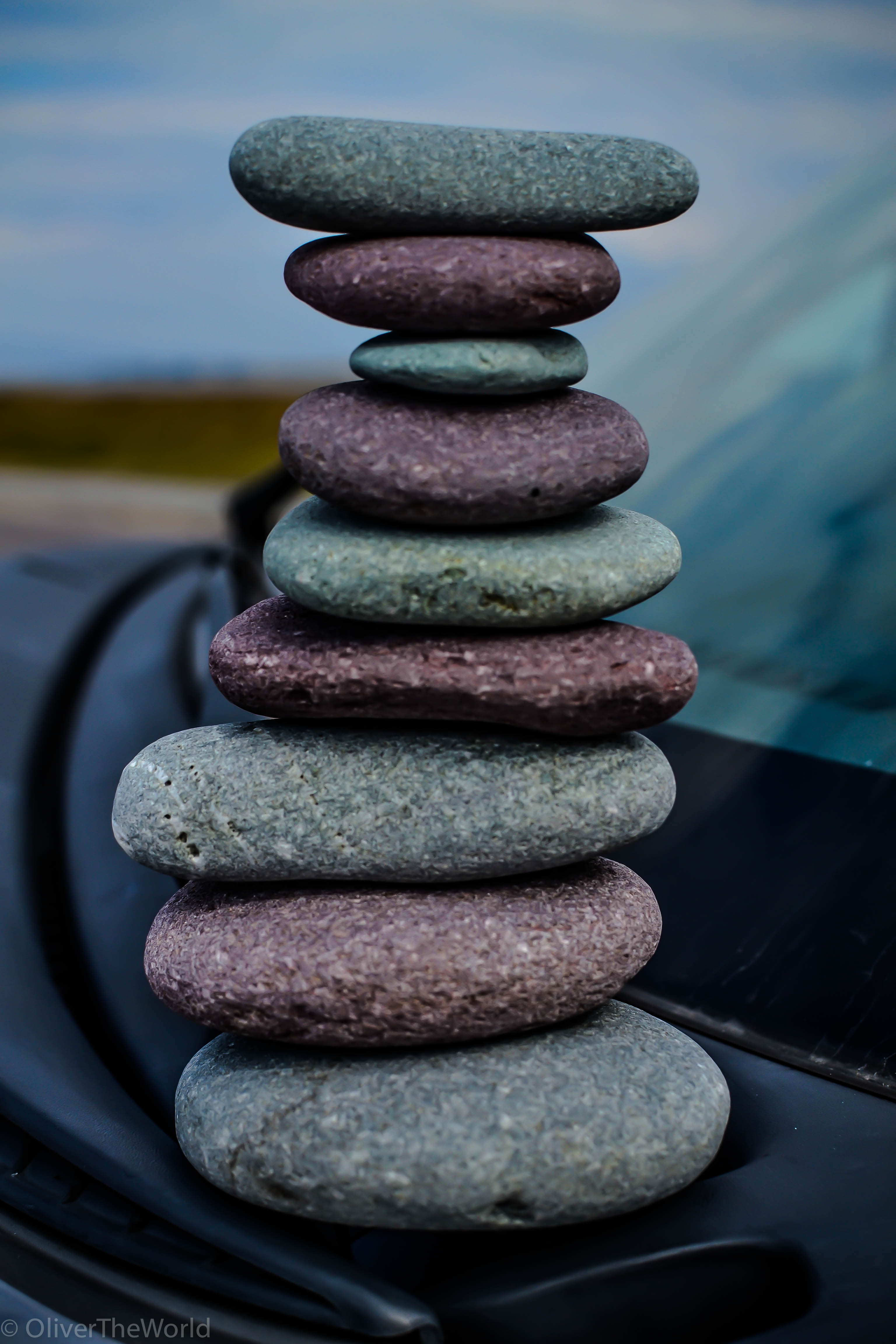
For the remainder of our time, aside from enjoying the palatial expanse and modern conveniences of our temporary home – the finest accommodation we’ve had on our trip to date, bar none (equipped with a sauna, so spoiled were we) – we continued to seek out nameless roads scattered along the Kerry Way. One afternoon found us erecting cairns out of the curious purple and green stones that littered the blue-flag beach at Rossbeigh.
On another occasion, after an aborted tour of the stuffy Victorian mansion at Muckross on account of an irritable 21 month old, we wandered off into Killarney National Park and got hopelessly lost. After the Torc Waterfall and the panoramic stop at Lady’s View, our GPS simply told us to press on rather than turn back, and nobody seemed to argue.

Somewhere after Moll’s Gap, we doglegged in toward the coast, crisscrossed a moor that had all the flavor of the Scottish Highlands, cut a broad swathe around the “Black Stacks”: Cnoc na Peiste, Carrauntoohil and the rest of the Reeks, and slipped neatly through the pass at Ballaghbeama Gap. An assortment of cattle tracks led us over the tri-arched Blackstones Bridge and wound us through ancient oak woodland before depositing us alongside the banks of our old friend, Caragh Lake. Our “detour” out of Killarney had literally brought us straight to our back door.
With time, perseverance (including one grandfather’s willingness to take the long way home despite a bad back ache) and blind faith in our little GPS, we painstakingly unraveled the “other” side of the Iveragh Peninsula to discover that the Ring of Kerry was only that and nothing more…a simple road linking one point to another. And anyone with any sense at all knows it’s always best to look between to look between those lines.

The post Off the Beaten Path in Ireland: Escaping the Ring of Kerry first appeared on OliverTheWorld.
]]>